
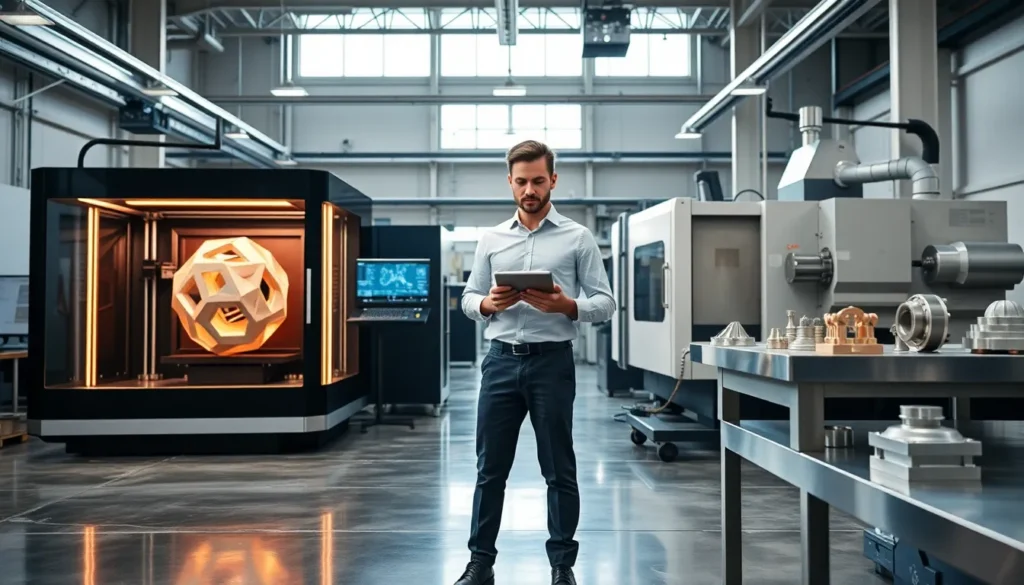
3D printing vs traditional manufacturing represents one of the most important decisions in modern production. Both methods create physical objects, but they do so in fundamentally different ways. 3D printing builds items layer by layer from digital files. Traditional manufacturing uses subtractive or formative processes to shape raw materials.
Businesses, engineers, and hobbyists face this choice regularly. The right decision depends on factors like budget, timeline, production volume, and part complexity. This guide breaks down how each method works, their key differences, and when one approach makes more sense than the other.
Table of Contents
ToggleKey Takeaways
- 3D printing vs traditional manufacturing comes down to volume—3D printing is cost-effective for 1-100 units, while traditional methods win at 10,000+ units.
- 3D printing offers unmatched design freedom, enabling complex geometries like internal channels and lattice structures impossible with traditional methods.
- Traditional manufacturing requires significant upfront tooling investment ($10,000+), but delivers extremely low per-unit costs at high volumes.
- Choose 3D printing for prototyping, custom products, and low-volume production where speed and flexibility matter most.
- Traditional manufacturing wastes 60-80% of raw material through subtractive processes, while 3D printing uses only what’s needed for the part.
- For rapid prototyping, 3D printing delivers first articles in hours or days compared to weeks or months for traditional tooling development.
How 3D Printing Works
3D printing, also called additive manufacturing, creates objects by depositing material layer by layer. The process starts with a digital 3D model, typically created in CAD software or downloaded from online repositories.
A slicer program converts the 3D model into instructions the printer can follow. These instructions tell the printer exactly where to place material for each layer. Most consumer and industrial 3D printers use one of several core technologies:
- FDM (Fused Deposition Modeling): Melts plastic filament and extrudes it through a heated nozzle. This is the most common and affordable method.
- SLA (Stereolithography): Uses UV light to cure liquid resin into solid layers. It produces smoother, more detailed parts.
- SLS (Selective Laser Sintering): Fuses powdered materials using a laser. It works well for functional prototypes and end-use parts.
3D printing requires minimal setup compared to traditional methods. Users load a file, prepare the build plate, and press start. No molds, dies, or specialized tooling are needed. This makes 3D printing ideal for one-off parts, custom designs, and rapid prototyping.
Print times vary from minutes to days depending on part size and detail. Material options have expanded significantly and now include plastics, metals, ceramics, and even food-safe materials.
How Traditional Manufacturing Works
Traditional manufacturing encompasses several established processes that have powered industry for decades. These methods generally fall into two categories: subtractive and formative.
Subtractive manufacturing removes material from a solid block to create the final shape. CNC machining is the primary example. A computer-controlled machine uses cutting tools to carve away material with high precision. This method works well for metal parts that need tight tolerances.
Formative manufacturing shapes material using force, heat, or pressure. Common examples include:
- Injection molding: Forces molten plastic into a mold cavity. The plastic cools and hardens into the desired shape.
- Casting: Pours liquid metal or plastic into a mold and allows it to solidify.
- Forging: Uses compressive forces to shape metal, typically while heated.
Traditional manufacturing excels at high-volume production. Once a mold or tooling is created, factories can produce thousands or millions of identical parts quickly and cheaply. The per-unit cost drops dramatically as volume increases.
But, traditional methods require significant upfront investment. Creating molds and tooling can cost thousands to hundreds of thousands of dollars. Design changes often mean creating entirely new tooling, which adds time and expense.
Key Differences Between 3D Printing and Traditional Methods
The 3D printing vs traditional manufacturing debate comes down to several critical factors. Understanding these differences helps businesses and individuals make informed decisions.
Design Freedom
3D printing offers nearly unlimited geometric freedom. It can create internal channels, lattice structures, and organic shapes that would be impossible with traditional methods. Traditional manufacturing requires designs that can be removed from molds or accessed by cutting tools.
Material Waste
3D printing uses only the material needed for the part plus supports. Traditional subtractive methods often waste 60-80% of raw material as chips and scrap. This makes 3D printing more sustainable for certain applications.
Labor and Skill Requirements
Traditional manufacturing often requires skilled machinists and operators. 3D printing reduces manual labor since the machine handles most of the work automatically. But, post-processing 3D printed parts may still require skilled technicians.
Cost and Speed Considerations
Cost comparison between 3D printing vs traditional manufacturing depends heavily on volume.
For low volumes (1-100 units), 3D printing typically wins. There’s no tooling cost, and setup takes minutes instead of weeks. A prototype that costs $50 to 3D print might require $10,000 in mold costs for injection molding.
For high volumes (10,000+ units), traditional manufacturing becomes far more economical. Once tooling is paid off, injection molding can produce parts for pennies each. 3D printing costs remain relatively constant per unit regardless of volume.
Speed follows a similar pattern. 3D printing delivers first articles in hours or days. Traditional manufacturing may take weeks or months for tooling development. But once production starts, traditional methods produce parts much faster, often hundreds per hour versus one 3D printed part over several hours.
The crossover point varies by industry and part complexity. Some analyses suggest 3D printing remains cost-competitive up to 500-1,000 units for plastic parts.
When to Choose 3D Printing Over Traditional Manufacturing
Knowing when to use 3D printing vs traditional manufacturing saves time, money, and frustration. Here are the scenarios where 3D printing makes the most sense:
Prototyping and Product Development
3D printing shines during early design phases. Engineers can test multiple iterations in days rather than weeks. Failed designs cost relatively little, encouraging experimentation and innovation.
Custom and Personalized Products
Medical devices, dental aligners, and hearing aids benefit from 3D printing. Each item can be unique without additional tooling costs. The same applies to custom consumer products like jewelry or phone cases.
Low-Volume Production
Startups and small businesses often can’t justify traditional manufacturing’s upfront costs. 3D printing lets them produce inventory on demand without warehousing thousands of units.
Complex Geometries
Parts with internal cooling channels, lightweight lattice structures, or organic shapes often can’t be made any other way. Aerospace and automotive industries increasingly use 3D printing for these applications.
Spare Parts and Obsolete Components
When original tooling no longer exists, 3D printing can recreate discontinued parts. This extends equipment life and reduces dependency on original manufacturers.
Traditional manufacturing remains the better choice for high-volume commodity parts, materials that can’t yet be 3D printed effectively, and applications requiring surface finishes or tolerances beyond current 3D printing capabilities.