
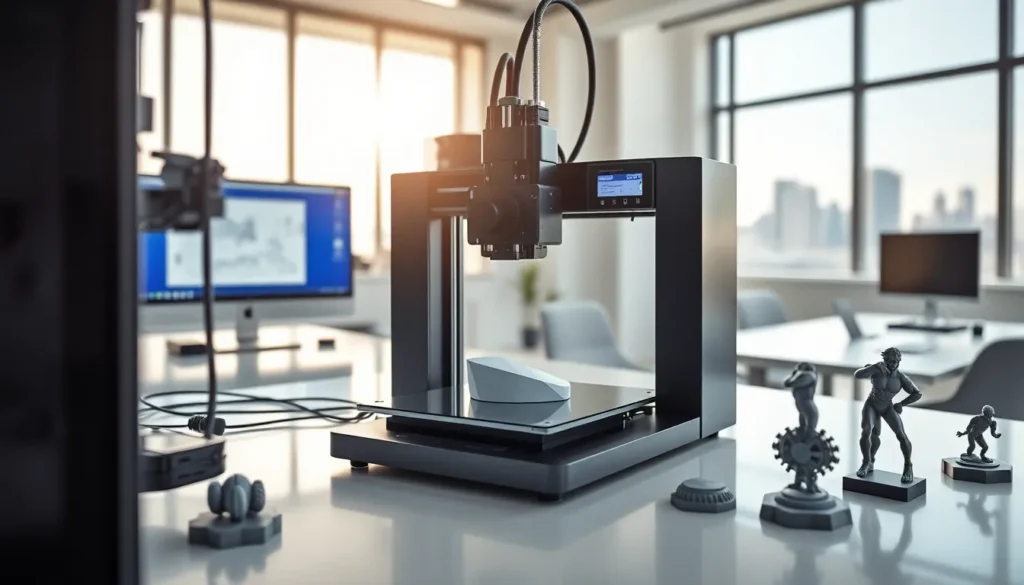
What is 3D printing? At its core, 3D printing is a manufacturing process that creates physical objects from digital designs. Instead of cutting material away (like traditional machining), 3D printing builds objects layer by layer from the ground up. This approach is why it’s also called additive manufacturing.
The technology has moved far beyond its early days as a niche prototyping tool. Today, 3D printing produces everything from custom dental implants to aerospace components to the toy sitting on your desk. Whether someone is a hobbyist curious about desktop printers or a business exploring industrial applications, understanding how 3D printing works opens doors to new possibilities.
Table of Contents
ToggleKey Takeaways
- 3D printing is an additive manufacturing process that builds physical objects layer by layer from digital designs.
- Common 3D printing technologies include FDM for affordable home use, SLA for fine details, and SLS for complex industrial parts.
- Materials range from beginner-friendly PLA plastic to advanced options like metal powders, resins, and even bioprinting with living cells.
- 3D printing excels in healthcare, aerospace, and prototyping where customization, complex geometries, and rapid iteration are essential.
- While 3D printing offers design freedom and reduced waste, it’s slower than traditional manufacturing for high-volume production.
- The technology complements traditional manufacturing by enabling rapid prototyping, custom parts, and local on-demand production.
How 3D Printing Works
3D printing follows a straightforward workflow. First, a designer creates a 3D model using CAD (computer-aided design) software. Programs like Tinkercad, Fusion 360, or Blender let users build digital objects from scratch. Alternatively, users can download pre-made designs from online repositories.
Once the digital model is ready, specialized software called a slicer takes over. The slicer converts the 3D model into thin horizontal layers and generates instructions (G-code) that tell the printer exactly where to deposit material. Think of it like slicing a loaf of bread, each slice becomes one layer the printer will create.
The 3D printer then builds the object one layer at a time. Depending on the technology, it might melt plastic filament, cure liquid resin with UV light, or fuse powder particles together. Each layer bonds to the one below it. After minutes, hours, or even days (for large prints), the physical object emerges.
Post-processing often follows. This might include removing support structures, sanding rough surfaces, or curing parts under additional UV light. The specific steps depend on the 3D printing technology and material used.
Common Types of 3D Printing Technology
Several 3D printing technologies exist, each with distinct strengths.
Fused Deposition Modeling (FDM)
FDM is the most common 3D printing method for home and office use. A heated nozzle melts thermoplastic filament and deposits it in precise patterns. FDM printers are affordable, widely available, and work with many materials. But, they produce visible layer lines and have lower resolution than other methods.
Stereolithography (SLA)
SLA uses a UV laser to cure liquid photopolymer resin layer by layer. This 3D printing technology produces smooth surfaces and fine details, making it popular for jewelry, dental models, and miniatures. SLA parts require post-curing and careful handling of liquid resins.
Selective Laser Sintering (SLS)
SLS uses a laser to fuse powdered material, typically nylon, into solid structures. Because unfused powder supports the part during printing, SLS doesn’t need separate support structures. This makes it excellent for complex geometries. SLS is primarily an industrial 3D printing technology due to equipment costs.
Multi Jet Fusion (MJF)
HP developed MJF for high-speed production. It uses fusing agents and infrared light to bond nylon powder. MJF delivers consistent mechanical properties and fast print times, making it attractive for manufacturing end-use parts.
Materials Used in 3D Printing
Material selection dramatically affects what 3D printing can achieve.
Thermoplastics dominate consumer 3D printing. PLA (polylactic acid) is beginner-friendly and biodegradable. ABS offers more durability and heat resistance. PETG balances ease of printing with mechanical strength. Specialty filaments include flexible TPU, carbon-fiber composites, and even wood-filled materials.
Photopolymer resins serve SLA and similar technologies. Standard resins work for general prototyping. Engineering resins mimic properties of ABS or polypropylene. Dental and castable resins address specific professional needs.
Metal powders enable industrial 3D printing of functional parts. Stainless steel, titanium, aluminum, and Inconel are common choices. Metal 3D printing creates components for aerospace, medical implants, and automotive applications.
Other materials continue expanding what’s possible. Ceramics, concrete, and even chocolate have been 3D printed. Bioprinting research uses living cells to work toward printable tissues and organs.
The right material depends on the application. A decorative figurine needs different properties than a load-bearing bracket.
Popular Applications of 3D Printing
3D printing has found its way into nearly every industry.
Prototyping remains a primary use. Designers can test form, fit, and function in hours rather than weeks. This speeds up product development cycles and reduces costs.
Healthcare has embraced 3D printing enthusiastically. Custom prosthetics fit individual patients perfectly. Surgeons practice complex procedures on 3D-printed organ models. Dental labs produce crowns, aligners, and surgical guides daily.
Aerospace and automotive industries use 3D printing for lightweight components. Printed parts can feature internal lattice structures that reduce weight while maintaining strength, impossible with traditional manufacturing.
Consumer products increasingly come from 3D printers. Eyewear companies print custom-fit frames. Shoe manufacturers print midsoles. Even furniture designers create pieces only possible through additive methods.
Education benefits as 3D printing brings abstract concepts to life. Students can hold a model of a molecule, a historical artifact replica, or their own design project.
Spare parts and repairs represent a growing application. Instead of waiting weeks for a replacement part, owners can print it themselves or have it printed locally.
Benefits and Limitations of 3D Printing
Understanding both the advantages and constraints helps set realistic expectations for 3D printing.
Benefits
- Design freedom: 3D printing creates geometries impossible with traditional manufacturing. Internal channels, organic shapes, and consolidated assemblies become achievable.
- Rapid iteration: Changes to a design can be printed the same day. No tooling changes, no long lead times.
- Customization: Each print can be unique at no extra cost. Mass customization becomes economical.
- Reduced waste: Additive manufacturing uses only the material needed for the part, unlike subtractive methods that cut away excess.
- Local production: Parts can be printed near where they’re needed, reducing shipping and inventory costs.
Limitations
- Speed: 3D printing is slow compared to injection molding for high volumes. A mold can produce thousands of parts while a printer makes one.
- Material properties: Printed parts often don’t match the strength or consistency of traditionally manufactured equivalents, though this gap is closing.
- Size constraints: Build volumes limit how large a single print can be. Very large objects require assembly or specialized equipment.
- Surface finish: Many 3D printing technologies produce visible layer lines that require post-processing to smooth.
- Cost at scale: For large quantities, traditional manufacturing usually wins on per-unit cost.
3D printing excels where customization, complexity, or speed-to-first-part matters most. It complements, rather than replaces, traditional manufacturing methods.